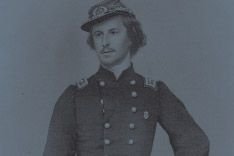
| In 1910, Humphreys resigned his commission
to attend to the family business, the Humphreys Homeopathic Medicine Company,
founded by his grandfather in 1853. Thereafter he served as an officer
of the company, the last twelve years of his life as its president. He
greatly expended its worldwide operations, particularly in South America.
In June of 1915, Humphreys joined the New York
National Guard's 22d Engineers Regiment as a First
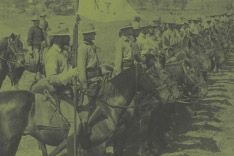
Lieutenant. Called up with his regiment for Mexican
Border service after Pancho Villa's raids in 1916, he
served as an aide to Major General John F. O'Ryan,
Commanding General of the New York (later 27th) Division.
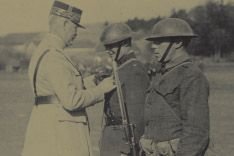
Shortly after his return to New York, the regiment was
inducted into federal service for World War I. After
initial service with his regiment at the divisional
training post at Spartansburg, South Carolina, Humphreys
aviation experience was recalled and he was transferred
to the Army Air Service in January, 1918. After
refamiliarization flight training at Rockwell Field in
San Diego, he was assigned to the first class of the
School of Military Aeronautics at the Massachusetts
Institute of Technology for advanced technical training.
Upon graduation, he was retained as head of the
Department of Practical Aircraft Design, and
subsequently, school commander. At about the time of the
Armistice, he was assigned to the newly founded Technical
Section, Engineering Division, at McCook Field, Dayton,
Ohio, remaining there until demobilized in February,
1919.
Returning to New York, Humphreys was appointed Colonel
of the 102d Engineers, a position he remained until his
retirement due to ill health on July 11th, 1939. At the
time he was the senior Colonel of the state. Shortly
thereafter, was advanced to Brigadier General on the
State Retired List.
Throughout his life Humphreys was active in business
and civic associations. These included: the National
Foreign Trade Council, the New York Board of Trade, the
American Museum of Natural History, the National
Geographic Society, the American Legion, the Institute of
Aeronautical Science, and the Association of Graduates at
West Point.
Recuperating from pneumonia in Miami Beach, General
Humphreys suffered a fatal heart attack on January 20th,
1941, at the age of 57. Myrtle Lee, his wife of 31 years
was at his side. Writing in that year's annual report
of the Association of Graduates, a West Point classmate
said of him:
"When I come to sum up the many sides of his
life, I shall award to him seven stars for seven
accomplishments, any one of which would be proudly worn
by any man, to represent a life well lived. That he was
not content with one or two or three, but strove to
master his task in each new field of labor and to mark
his record with a star, is to me a sign of genius and
strength far above that which shows in other
men."
On the fiftieth
anniversary of his historic flight, his widow joined the
Commanding General of the US Army Engineer School and
Fort Belvoir at the unveiling of a bronze plaque honoring
him.
Article by: R.H. vonHasseln, DMNA
Historian

|
First Flight
On August 1, 1907, the U.S. Army Signal Corps
established an Aeronautical Division to "take charge
of all matters pertaining to military ballooning, air
machines, and all kindred subjects.'
Shortly thereafter, bids were placed for flying
machines, and officers detailed to the Signal Corps for
instruction in operating the same.
Only one bidder successfully produced a plane: The
Wright Brothers. In 1908, while demonstrating this plane,
it crashed and severely injured Orville Wright, pilot,
and killed Lieutenant Selfridge, passenger. Selfridge,
who had previously soloed on his own in a civilian craft,
was the first military aviation casualty. The plane would
be rebuilt and resubmitted.
"Aeroplane No. 1, Heavier-than-Air Division, US
Aerial Fleet" was officially accepted by the US Army
on August 2, 1909. 800 pounds of bamboo, wire and cloth,
and a 30 hp engine connected to propellers by bicycle
chains had cost the government $30,000. Included in the
contract was the requirement for the Wright Brothers to
train and certify two military officers as pilots. These
were to be Lieutenants Lahm and Foulois; the latter,
however, was dispatched to attend the International
Congress of Aeronautics in Europe, and Lieutenant
Frederick E. Humphreys was detailed to take his
place.
Vacant land near College Park, Maryland, was leased
and cleared and a temporary hanger erected. Wilbur Wright
undertook training the two officers in early October.
Shortly after 8 am on October 26, 1909, a mechanic
held a gasoline soaked rag over the engine intake while
another cranked the engine into life. Wilbur Wright
hurriedly ran to a nearby shed for windowsash weights to
replace his weight in the passenger seat. After a little
over three hours of actual flying time, Lieutenant
Humphreys became the first military student pilot to be
told he was ready to "take her up on your own." A catapult weight dropped, and plane and pilot were
assisted aloft for a three minute flight.
Two more flights were made by Lieutenant Humphreys
that day, the next of eight and one half minutes, and the
last of twenty-four minutes. Lieutenant Lahm also soloed
for three flights, and Wilbur Wright pronounced both "certified pilots." Over the next few days the
two flew practice flights together and separately, until
November 5th, when they crashed the plane and American
military aviation came to an abrupt and temporary
end.
Winter weather was setting in, Lahm's detail from
the Cavalry was about to expire, and there were no funds
left for repair of the aircraft. Humphreys returned to
the Corps of Engineers, and the broken plane was shipped
to Fort Sam Houston, Texas, where Foulois attempted to
put in back together in his spare time while teaching
himself to fly by correspondence course.
Foulois would later become a Major General and Chief
of the Air Corps. Lahm and Humphreys, Brigadier Generals
in the Air Corps and New York National Guard
respectively. By 1911, Aircraft No. 1 was no longer
serviceable and was donated to the Smithsonian
Institution.
And the rest, as they say, is history.
|